
IP ratings: A guide to select the best machine for your industrial environment

IP ratings define how well industrial equipment is protected against dust and water, ensuring reliability, safety, and compliance in challenging environments. Understanding these ratings helps manufacturers and operators choose the right machines to prevent damage, reduce downtime, and extend equipment life.
What are IP ratings and why do they matter?
IP or ‘Ingress Protection’ ratings are standardized codes that identify the protection a piece of equipment has against intrusion of solid particles (dust) and liquid (water). These ratings are critical in industrial environments where equipment and electronic components can be exposed to challenging conditions.
IP ratings are defined in IEC 60529, which is an international standard that rates the resistance of enclosures of electric and electronic devices against the intrusion of dust and liquids. It also rates how easy it is to access the potentially hazardous parts inside the enclosure. IEC 60529 ratings allow manufacturers to sell their products in Europe and other areas outside of North America.
What is the difference between IP54 and IP65 ratings?
Two of the most common IP ratings for industrial equipment are IP54 and IP65.
- IP54: Dust-protected and resistant to water splashes.
- IP65: Dust-tight and resistant to water jets.
The IP54 rating level with a leading digit of 5 means that for solid particle protection, the equipment is dust protected. The enclosure provides complete protection from contact and prevents large quantities of dust from entering. The second digit of 4 indicates protection is provided against water splashing against the enclosure from any direction. Enclosures carrying an IP54 rating are suitable for “moderately” dusty environments or settings where water may splash on the outside of the equipment.
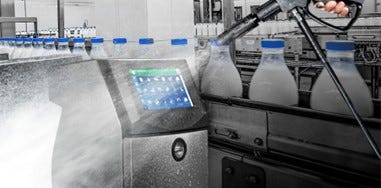
For IP65 the first digit of 6 in this rating level means the sold particle protection provided is dust tight, with complete protection from contact and no entry of dust. The second digit being 5 means the enclosure is protected against water projected by jets coming from any direction.
IP rating chart: Dust and water protection levels
| Dust protection | Water protection | |||
| First Number | Definition | Second Number | Definition | Tests |
| 0 | No protection | 0 | No protection | None |
| 1 | Protected against objects > 50mm (hands) | 1 | Dripping: Vertically falling drops of dripping water shall have no harmful effect. | Test duration: 10 minutes Water volume: equivalent to 1mm rainfall per minute |
| 2 | Protected against objects > 12mm (fingers) | 2 | Tilted drops: Vertically dripping water shall have no harmful effect when the enclosure is tilted at an angle up to 15° from its normal position. | Test duration: 10 minutes Water volume: equivalent to 3mm rainfall per minute |
| 3 | Protected against objects > 2.5mm (tools/wires) | 3 | Spraying: Water falling as a spray at any angle up to 60° from the vertical shall have no harmful effect. | Test duration: 5 minutes Water volume: 0.7 liters per minute Water pressure: 80–100 kPa |
| 4 | Protected against objects > 1mm (small tools) | 4 | Splashing: Water splashing against the enclosure from any direction shall have no harmful effect. | Test duration: 5 minutes Water volume: 10 liters per minute Water pressure: 80–100 kPa |
| 5 | Dust protected but not air tight | 5 | Water jets: Water projected by a nozzle (6.3mm) against enclosure from any direction shall have no harmful effects. | Test duration: at least 3 minutes Water volume: 12.5 liters per minute Water pressure: 30 kPa at distance of 3m |
| 6 | Dust tight – Totally protected against dust | 6 | Powerful water jets: Water projected in powerful jets (12.5mm nozzle) against the enclosure from any direction shall have no harmful effects. | Test duration: at least 3 minutes Water volume: 100 liters per minute Water pressure: 100 kPa at distance of 3m |
| 7 | Immersion: Ingress of water in harmful quantity shall not be possible when the enclosure is immersed in water up to 1m. | Test duration: 30 minutes Water volume: immersion at depth of 1m | ||
| 8 | Immersion: Equipment is hermetically sealed such that continuous immersion in water more than 1m shall have no harmful effects. Depth specified by manufacturer. | Test duration: continuous immersion in water | ||
Explore our full range of IP-rated printers and labeling solutions.



