corrugated box coding, large character marking, print and apply labeling, corrugate material
Corrugated cardboard boxes are typically printed with shipping, handling, and product identification codes that must remain readable throughout storage, handling, and distribution.
Corrugated packaging presents different challenges than primary packaging. The surfaces of corrugated materials vary by supplier and can be rough or absorbent, and corrugated boxes often shift position as they proceed on conveyors. Codes are frequently scanned downstream by warehouses, carriers, and retailers, where readability, placement, and consistency matter more than fine print detail.
For these reasons, corrugated coding solutions are selected based on:
Required character size and scanning conditions
Consistency across variable box surfaces
Production speed and box spacing
Compliance with retailer and logistics requirements
Why large character marking (LCM) is widely used on corrugated packaging
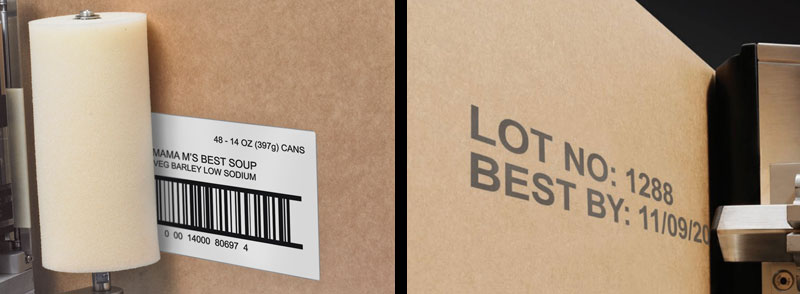
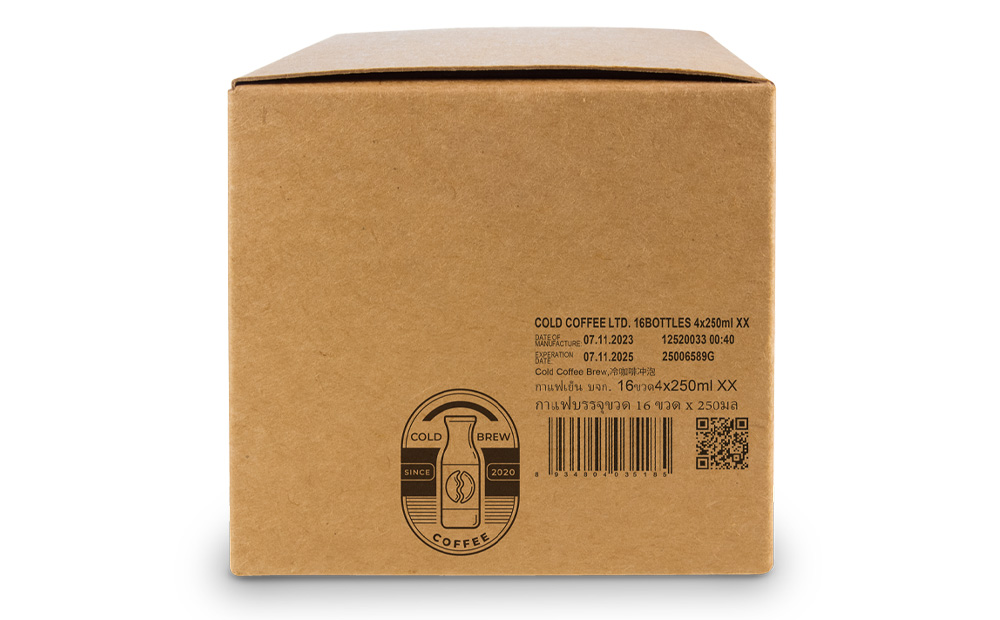
Large character marking is a primary solution for printing variable information directly onto corrugated boxes. LCM systems are available in both low‑resolution and high‑resolution formats, allowing manufacturers to match print quality to the application. Low‑resolution LCM is commonly used for bold case codes on porous corrugated materials. High‑resolution LCM is used when applications require tighter layouts or more detailed information including barcodes, 2D codes, and graphics printed directly on secondary packaging.
LCM is recommended when:
You want to print directly on corrugated packaging rather than apply a label
Low‑resolution printing is sufficient for the case information (for example, simple text codes)
High‑resolution printing is required for denser text or barcodes and the line can support consistent print conditions
You are managing cost per mark and want to avoid ongoing label material and ribbon costs
Box size, orientation, or surface quality varies and a robust, direct‑to‑box approach is needed
In high-volume applications, LCM is often selected for its simplicity and reduced material handling.
Typical use cases include product identification, destination codes, handling instructions, and logistics data printed on case sides or ends.
In controlled applications, high‑resolution LCM systems can also produce linear barcodes that meet GS1 scannability requirements when contrast, print quality, and placement are properly managed.
When print-and-apply labeling (LPA) is the right approach
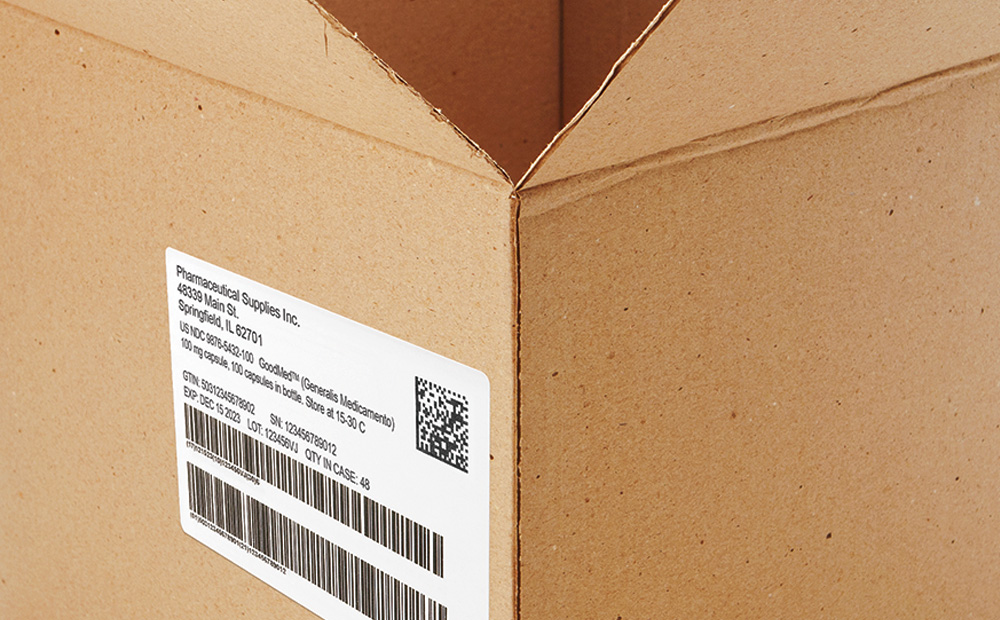
Print-and-apply labeling is used when information requirements exceed what direct printing can reliably deliver across variable corrugated quality, multiple scanning environments, or strict retailer requirements. Labels are not limited to barcodes; in shipping and distribution environments, they often carry multiple data elements required for identification, routing, and compliance.
LPA is recommended when:
Information density is high
Variable shipping data must be updated in real time
Retailer, carrier, or GS1 compliance is required
The same box format supports multiple distribution paths
Consistent barcode contrast and readability must be maintained across different corrugated surfaces and environments
Multiple code placements may be required, including applications where more than one panel of a case must be labeled
Labels applied to cartons and cases may include product descriptions, destination details, handling symbols, best before dates, lot or batch data, and linear or 2D barcodes. Printing this information onto a label helps ensure consistent readability when corrugated quality varies. In addition, label applicators can support specific placement requirements, such as applying a single label that wraps across two sides of a case, allowing certain compliance needs to be met within a single integrated system.
When laser marking is recommended for corrugated boxes
Laser marking is recommended when corrugated materials are laser‑receptive and the goal is permanent, ink‑free marking. CO₂ laser systems can produce high‑resolution text, graphics, and codes on boxes designed to respond to laser energy.
Laser marking is most effective when:
Boxes are white, coated, or treated with a laser‑reactive surface
Print zones are consistent and validated for contrast
An ink‑free marking process is preferred
Line configuration supports fixed marking positions
Because lasers do not always produce sufficient contrast on standard brown corrugate, laser solutions are typically selected only after material compatibility is confirmed.
Why CIJ and TIJ are not the default choices for corrugated boxes
Continuous inkjet (CIJ) is widely used for small‑character coding on primary packaging, but CIJ on corrugated boxes is typically not a first‑choice approach because of how the technology interacts with porous, uneven surfaces. CIJ systems are optimized for close‑range printing of compact codes rather than large, case‑level information.
On corrugated packaging, challenges can include maintaining consistent print quality across rough or absorbent surfaces, achieving sufficient character size for long‑distance scanning, and controlling placement when boxes vary in height or position. As a result, CIJ is generally used on corrugated boxes only in limited or controlled applications.
Thermal inkjet (TIJ) can produce high‑resolution print, but it requires more controlled production conditions than many corrugated lines provide. TIJ systems perform best when box presentation, print distance, and line speed are consistent and well managed.
In high‑speed corrugated case‑handling environments, variations in box surface quality, spacing, or alignment can affect print reliability. In practice, TIJ is often used on pharmaceutical products, including cartons and foil, where high print quality is required and conditions can be tightly maintained.
How to choose the right corrugated coding solution
The effectiveness of a corrugated coding solution depends on how well it performs under actual production and distribution conditions. Codes must remain readable as boxes move through variable handling, storage, and scanning environments.
When selecting a technology, consider:
Required code size and where the code will be scanned
Line speed and box‑handling behavior
Variability in corrugated material and surface quality
Downstream scanning and compliance requirements
In many shipping and distribution environments, large character marking (LCM) and print-and-apply labeling (LPA) can provide the most consistent results across changing box conditions. Other technologies are used when application requirements allow for tighter control or specify certain substrate characteristics.
Coding technology comparison
Large character marking (LCM) is typically selected when information is printed directly on corrugated packaging and must tolerate variation in box surface, size, or orientation.
Print-and-apply labeling (LPA) is recommended when cartons must carry higher information density, variable shipping data, or strict logistics or retailer requirements.
Thermal inkjet (TIJ) may be suitable when high‑resolution printing is required and print distance, box presentation, and line speed are tightly controlled.
Laser marking is an option when corrugated materials are laser‑receptive and consistent contrast can be achieved.
Continuous inkjet (CIJ) may be used for limited, close‑range coding or when application requirements fall outside the strengths of other technologies.
In short: corrugated box coding options
Corrugated box coding technologies are selected based on the level of information required, the consistency of the substrate, and how much variation exists in the production environment. LCM is commonly used for direct-to-box coding where robustness and tolerance to surface variation are important. LPA is typically used when cartons must carry more complex or variable information while maintaining consistent readability across mixed corrugated quality.
TIJ can be used in controlled environments where higher resolution is needed and box presentation remains stable. Laser marking may be considered when the corrugated substrate is receptive and the production line can support consistent marking conditions. CIJ is generally suited to smaller character applications rather than most case-level corrugate coding needs.
FAQs
What information is printed on corrugated shipping boxes?
Corrugated boxes often carry product identification, handling instructions, destination details, batch or lot data, and logistics barcodes used throughout the supply chain.
Is direct printing or labeling better for corrugated packaging?
Direct printing is often preferred for speed and simplicity, while labeling is typically chosen when information density, variability, or compliance requirements are higher.
Do print-and-apply labels only contain barcodes?
Print-and-apply labels can carry more than a barcode. In addition to linear and 2D barcodes, labels are commonly printed with text, symbols, and multiple variable data elements such as destination details, lot or batch information, handling instructions, and compliance information.
Can GS1 barcodes be printed directly on corrugated boxes?
Yes. GS1 barcodes, including GS1‑128 and ITF‑14, as well as 2D codes powered by GS1 Digital Link, can be printed directly on corrugated cardboard boxes. The printed code must be verified to meet GS1 quality and scannability requirements. GS1 standards evaluate the barcode itself, not the printing technology used to produce it.
In practice, direct‑to‑box printing using industrial inkjet systems can support GS1 barcodes when print quality, contrast, size, and placement are well controlled.
Talk with a corrugated coding specialist
Corrugated packaging varies widely by application, environment, and distribution requirements. A coding specialist can help assess substrates, line speed, scanning needs, and integration points to determine whether LCM, LPA, TIJ, or laser marking is the best fit for your operation.